
The shelf life of a B-List celebrity anywhere is usually short lived. In New Zealand, that shelf is more of a skirting board, precariously propping up the VIP-guest-list and shopping-mall-opening dreams of our once slightly famous.
But for those not smart enough to start an orange juice company, what meaningful source of income remains, ten years after the spotlight (albeit, a weak one to begin with) fades? Not famous enough for Dancing With The Stars, too famous to work in Burger Fuel. Where to next for hostesses of 80’s game shows, singers of defunct 90’s, chicken-themed, dub-rock-lite bands, or the ex-cast of Shortland Street (those that didn’t attempt brief & unsuccessful careers overseas before ending up back on the show)?
In the apparently endless, mildly informative, and altogether embarrassing world of Advertorials, that’s where.
A long time ago, in a galaxy far, far away, known as Browns Bay, a pact was signed with the devil, or, at the very least, someone who looked a lot like him.
Until the afternoon of Monday, 25 May 1992, the received wisdom said that it was simply impossible, both physically and financially, to produce a television show in New Zealand that would last beyond two seasons. But on that fateful date, standing at the mythical crossroads of Glenfield and Wairau Roads, hours before the broadcast of his new soap, Shortland Street, the head of South Pacific Pictures, John Barnett made a bargain with the evil gods of network television, that would guarantee the future of season, after season (after season) of low-rent, locally produced television.
What he didn’t, and couldn’t, realise at the time, was that, by doing so, he had unleashed a terrible curse upon every actor who would ever appear on the show.
If New Zealand network news was dumbed-down any further, the Medical Council could name a retardation after it. The 5 minutes out of the nightly news hour that isn’t padded out by the weather, V8 motor racing, or commercials, is spun with such ‘down home’ colloquialism, euphemism and mispronunciation, that it reads like cross between Woman’s Day, and an episode of ‘The Wiggles’.

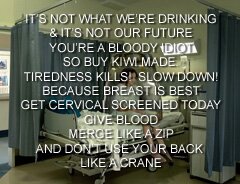
A typical Kiwi billboard ad.
Kiwis love being told what to do. And then doing the exact opposite.
In a, perhaps ironic, counterbalance to all the hours of Cheap TV Adverts on New Zealand television, the government happily invests millions of taxpayer’s money producing film-quality, 30-second vignettes and print ads, reminding us what a bunch dicks we all are, and how, if we only drink less/drive slower/eat lamb/exercise/breast feed/buy NZ/don’t bash our kids/& make it click, then this could, at last, be a really choice place to live.

And in other news...
Nothing happens in New Zealand. Ever.
And yet, against all better judgement, both TV networks feel compelled to provide a full hour of news coverage every evening. And how do they pad out the content, in a country where the biggest news event of the decade was the shearing of a stray, be-dreadlocked sheep? Segment after segment after segment of weather.

Don't upset the talent.
Small to medium sized Kiwi businesses just can’t seem to get enough of badly produced, low-rent TV commercials featuring themselves, their staff, or an immediate family member. And while she might be the apple of your eye, mate, with a face like a badly-healed motorcycle injury, your darling daughter is unlikely to shift a lot of budget leather sofas.